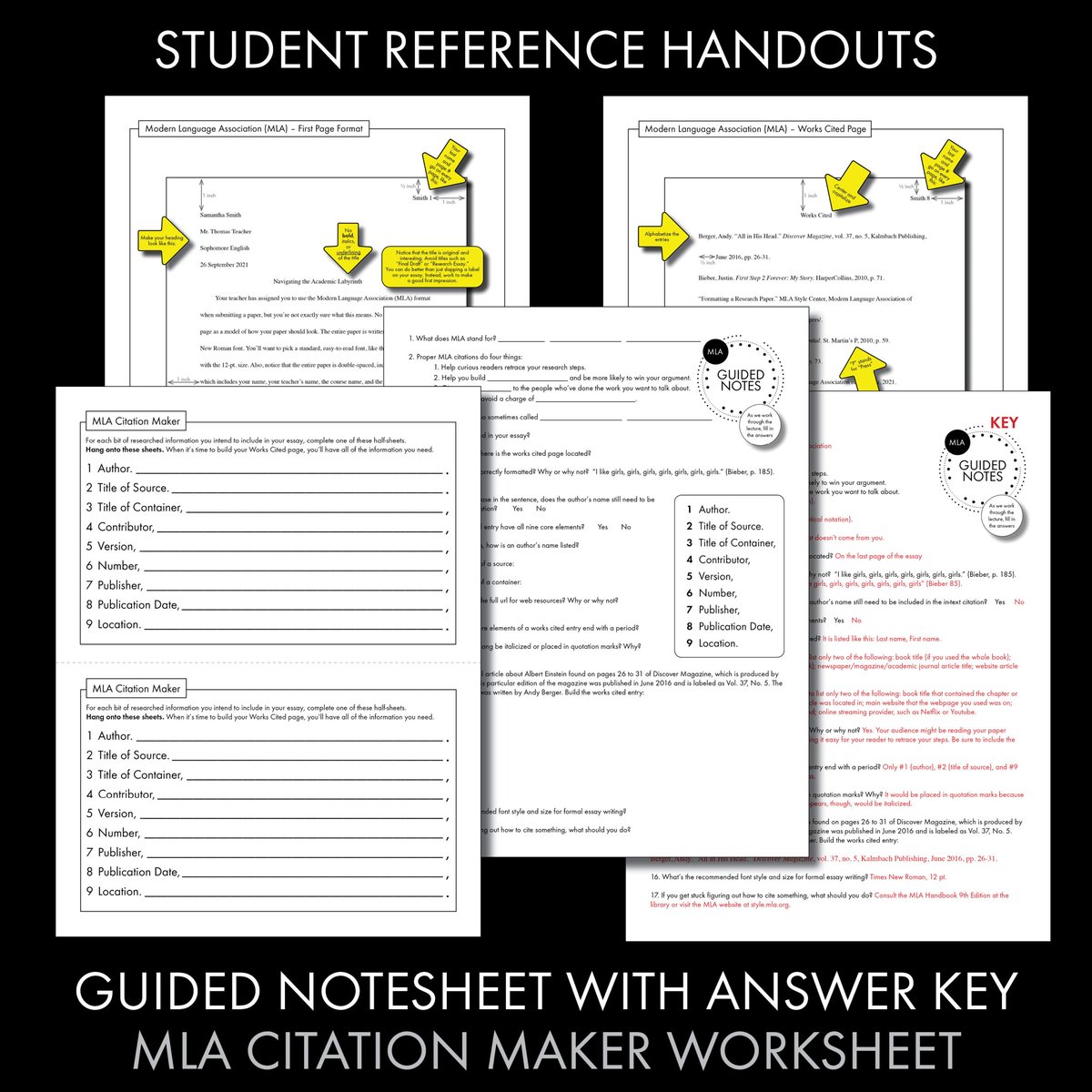
Feeling a bit lost in the ever-evolving world of academic citation? You're not alone. While the fundamental purpose of MLA style – to bring clarity and consistency to your research – remains unchanged, the Modern Language Association continually refines its guidelines to reflect the dynamic landscape of information. This guide is your trusted compass for Navigating MLA 9th Edition: Updates and How They Impact Your Citations, ensuring your academic work is not just technically sound but also effectively communicates your scholarly rigor.
At a Glance: What's New in MLA 9th Edition
- Expanded Guidance on Core Elements: Deeper dives and more examples for each of the nine building blocks of a citation.
- Hundreds of New Citation Examples: A significantly updated appendix to cover a wider array of sources.
- Nuanced In-text Citations: Clearer rules for complex scenarios, like authors with the same last name or using timestamps for audiovisual sources.
- Emphasis on Academic Integrity: Updated guidance on plagiarism prevention and the importance of ethical citation practices.
- Inclusive Language: New recommendations for writing with sensitivity and respect.
- Paper Formatting Guidelines: For the first time, comprehensive instructions on how to format your entire paper are included in the handbook.
- Refined Grammar & Punctuation: A dedicated section to brush up on writing mechanics.
- Guidance on Notes: How and when to effectively use footnotes or endnotes.
Why MLA Style Matters: A Quick Refresher
Before we dive into the updates, let's quickly re-anchor on why MLA style exists. Standing for the Modern Language Association, MLA Style is a universally recognized method for structuring academic papers and, crucially, crediting your sources. It’s more than just a set of rules; it's a shared language for scholars, particularly within disciplines like English, history, theology, and philosophy. Adhering to MLA allows your readers to:
- Easily Locate Your Sources: The Works Cited list acts as a roadmap to your research.
- Understand Your Argument's Foundation: In-text citations show exactly where your ideas come from.
- Evaluate Your Credibility: Proper citation demonstrates that you've engaged with existing scholarship responsibly.
- Avoid Plagiarism: The most critical reason – giving credit where credit is due is the cornerstone of academic honesty.
Think of it as the agreed-upon grammar for academic conversations. It ensures everyone is speaking the same language, making it easier to build upon existing knowledge and contribute new insights.
The Unchanged Foundation: MLA's Core Elements
Good news: the fundamental structure for building citations, the "Core Elements" framework introduced in the 8th edition, remains the backbone of MLA 9. You're still gathering nine pieces of information, when available, for each source:
- Author: Who created this?
- Title of source: What is it called?
- Title of container: Where did you find it? (e.g., a journal, a website, a book of essays)
- Other contributors: Were there editors, translators, or directors?
- Version: Is it a specific edition, like a revised edition?
- Number: Is there a volume or issue number?
- Publisher: Who published it?
- Publication date: When was it published?
- Location: Where can it be found? (e.g., page numbers, URL, DOI)
These elements are then strung together in a specific order, punctuated precisely, to form your Works Cited entry. The elegance of this system lies in its flexibility, allowing you to cite virtually any source by filling in the relevant blanks.
Deeper Dives: Expanded Guidance on Each Core Element
While the elements themselves haven't changed, the 9th edition provides significantly expanded guidance and examples for each of them (pp. 107-197). This means less guesswork, more clarity, and practical applications for even the trickiest sources.
Let's look at how these elements come together with some common source types, integrating the specific examples from Caldwell's guidelines:
1. Journal Article Found in a Library Database
Here, the journal itself is the primary container, and the database is a secondary container.
- Works Cited Entry: Lorensen, Jutta. “Between Image and Word, Color, and Time: Jacob Lawrence’s The Migration Series.” African American Review, vol. 40, no. 3, 2006, pp. 571-86. Academic Search Premier.
- In-text Citation: (Lorensen 577)
Notice how thevol.andno.clarify the specific issue, and the database name tells your reader exactly where you accessed it.
2. Newspaper Article Found in a Library Database
Similar to a journal, the newspaper is the first container, followed by the database.
- Works Cited Entry: Fessenden, Ford, et al. "The Battle for New York's Key Voting Blocs in the Primaries." New York Times, 19 Apr. 2016, p. A 14. ProQuest Central.
- In-text Citation: (Fessenden et al. A14)
The "et al." is crucial for sources with three or more authors, simplifying your citation without losing information. The page number formatA14is also important for newspaper sections.
3. Article from an Online News Source
For online-only articles, the website itself often acts as the primary container.
- Works Cited Entry: Chang, Kenneth. “NASA Will Send More Helicopters to Mars.” The New York Times, 27 July 2022.
- In-text Citation: (Chang)
When no page number is available for online sources, simply use the author's last name. If the author is mentioned in your prose, no in-text citation is needed.
4. Book
The simplest form, often with the book itself as the primary container.
- Works Cited Entry: Dorris, Michael, and Louise Erdrich. The Crown of Columbus. HarperCollins Publishers, 1999.
- In-text Citation: (Dorris and Erdrich 110-12)
Two authors are listed in the order they appear on the title page, with the first name inverted. For page ranges, use an en dash.
5. Article or Specific Chapter from a Book
Here, the chapter is the source, and the larger book is the container. This is a common scenario when you're citing an edited collection.
- Works Cited Entry: Copeland, Edward. “Money.” The Cambridge Companion to Jane Austen, edited by Copeland and Juliet McMaster, Cambridge UP, 1997, pp. 131-48.
- In-text Citation: (Copeland 135)
Note how "edited by" introduces the book's editors. This shows how multiple layers of "containers" can be handled.
6. Webpage on a Website
Webpages often lack an explicit author, requiring you to start with the title of the source.
- Works Cited Entry: “Infographic: Benefits of Language Learning.” Modern Language Association, 2022.
- In-text Citation: ("Infographic: Benefits of Language Learning")
When no author is present, use a shortened title (usually the first few key words) in quotation marks for your in-text citation.
7. Film on an App
This demonstrates the flexibility of the container system, showing how to cite a film and the platform you viewed it on.
- Works Cited Entry: Mamma Mia. Directed by Phyllida Lloyd, Universal Pictures, 2008. Netflix app.
- In-text Citation: (Mamma Mia) or (Mamma Mia 59:03-61:23)
The option to include timestamps for specific scenes is a fantastic update for media analysis, making your citations far more precise.
Beyond the Basics: Navigating Nuanced In-Text Citations
While the fundamental formatting for in-text citations remains consistent (author's last name and page number/location), MLA 9 offers updated guidelines for more nuanced situations (pp. 227-286). These refinements ensure clarity even when your sources present unique challenges:
- Two Authors with the Same Last Name: To avoid confusion, include the author's first initial. For example: (J. Smith 45) vs. (T. Smith 123).
- Using Timestamps for Audiovisual Sources: As seen with the Mamma Mia example, you can now specify exact timings (e.g., 59:03-61:23) when referring to a particular segment of a film, podcast, or video. This is incredibly helpful for media studies or anytime you're analyzing a specific moment.
- Citing Multiple Works by the Same Author: If you cite more than one work by the same author, include a shortened title of the specific work in your in-text citation: (Angelou, Caged Bird 12) vs. (Angelou, Gather Together 56).
- Corporate or Government Authors: If a source has an organizational author (e.g., National Institutes of Health), use the full name or a well-known abbreviation (e.g., NIH) in your parenthetical citation.
These specific scenarios highlight the MLA 9th edition's commitment to making your citations as precise and unambiguous as possible.
Upping Your Game: Beyond Just Citations
The 9th edition isn't just about dots and commas; it broadens its scope to cover essential aspects of academic writing. This holistic approach makes the handbook an invaluable resource for students.
Embracing Academic Integrity: Plagiarism Prevention and Purpose of Citation
Understanding how to cite is only half the battle; understanding why is the other. MLA 9 includes updated guidelines for students on the importance of citations and robust advice on plagiarism prevention (pp. 95-102). It reinforces the ethical obligation to acknowledge the intellectual contributions of others, emphasizing that proper citation is a mark of respect and a crucial step in building your own scholarly reputation.
This section serves as a powerful reminder that every citation is a testament to your honest engagement with the academic conversation. For more detailed advice, exploring resources on academic writing tips can provide further insights into constructing ethical and impactful arguments.
Cultivating Inclusive Language
Good writing is clear, precise, and respectful. The 9th edition introduces new recommendations for incorporating inclusive language in writing (pp. 89-94). This guidance encourages writers to:
- Use gender-neutral language: Opt for "they/them" or restructure sentences to avoid gendered pronouns when the gender is unknown or irrelevant.
- Avoid stereotypes: Challenge assumptions based on race, ethnicity, religion, age, disability, sexual orientation, or socioeconomic status.
- Prioritize person-first language: Say "a person with a disability" instead of "a disabled person."
- Be mindful of potentially offensive terms: Stay updated on current best practices for respectful terminology.
This emphasis reflects a broader academic commitment to fostering an equitable and respectful intellectual environment. Learning about inclusive language guidelines can significantly enhance the impact and reach of your writing.
Structuring Your Research: New Paper Formatting Guidelines
A significant addition to the 9th edition handbook is comprehensive guidance on how to format an entire paper in MLA style (pp. 1-14). This was a feature not explicitly included in the 8th edition handbook, which focused more narrowly on citation. Now, you'll find clear instructions on:
- Page numbering and headers: Where to place your last name and page number.
- Title page (optional) or header information: How to present your name, instructor's name, course, and date.
- Margins and spacing: Standard 1-inch margins and double-spacing throughout.
- Font and font size: Typically 12-point Times New Roman or a similar legible font.
- Section headings: How to effectively use headings to organize your paper.
Having these guidelines centralized makes preparing your manuscript much easier and helps ensure consistency from the first page to the last.
Polishing Your Prose: Spelling, Punctuation, and Grammar
Beyond formatting and citation, the 9th edition dedicates substantial space to fundamental writing mechanics (pp. 15-87). This section offers a valuable refresher on:
- Common grammatical pitfalls: Subject-verb agreement, pronoun usage, parallel structure.
- Punctuation rules: Commas, semicolons, colons, apostrophes, and quotation marks.
- Spelling conventions: Tips for avoiding common misspellings and when to hyphenate.
Think of this as your built-in style guide, helping you refine your sentences and present your ideas with maximum clarity. For a deeper dive into these mechanics, consider consulting a comprehensive grammar and punctuation guide.
Harnessing Notes: Using Footnotes and Endnotes
While MLA primarily uses parenthetical in-text citations, there are situations where footnotes or endnotes are appropriate. The 9th edition provides clear guidance on using notes in MLA style (pp. 287-291), explaining:
- When to use notes: For supplementary information, lengthy explanations, or acknowledgments that would disrupt the flow of your main text.
- How to format notes: Placement, numbering, and content.
- Distinction from Works Cited: Notes clarify or expand; Works Cited lists sources.
This section helps you determine when a brief parenthetical citation isn't enough, giving you tools to add layers of detail without cluttering your main argument.
A Wealth of Examples: The Updated Appendix
Perhaps one of the most immediately helpful updates is the significantly expanded appendix, now boasting hundreds of citation examples (pp. 303-346). This treasure trove covers an exhaustive range of source types, including:
- Traditional sources: Books, scholarly articles, essays.
- Audiovisual sources: Films, TV shows, podcasts, music.
- Digital-native sources: Websites, social media posts, emails, online forums.
- Unique sources: Reports, interviews, dissertations, lecture notes.
This means less time agonizing over how to cite an obscure blog post or a specific government report, and more time focusing on your actual research and writing. When in doubt, consult the appendix! You might also find that using a Free MLA citation generator can help streamline the process for standard source types, but remember to always double-check the output against the official guidelines.
Common Questions & Pitfalls to Avoid
As you navigate MLA 9th edition, keep these points in mind:
- "When in doubt, cite it." It's always better to over-cite than to plagiarize.
- Always check the latest edition. While the fundamental framework is stable, minor clarifications or new examples might appear. If your instructor specifies a certain edition, adhere to that.
- Don't rely solely on automated citation tools. While helpful, they aren't foolproof. Understand the core elements so you can spot errors.
- Consistency is key. Ensure your formatting is consistent throughout your paper and Works Cited list.
- URL vs. DOI: For online sources, prioritize a DOI (Digital Object Identifier) if available, as it's a more stable and permanent link. If not, include a URL. You generally don't need to include "https://" unless a publisher specifies it.
- Access Date: MLA 9 generally advises against including an access date for online sources unless the source is likely to change or disappear (e.g., a wiki, social media post without a permanent archive).
- Shortened Titles for In-text Citations: If an online source lacks an author and title, use a shortened version of the title from the Works Cited entry in your in-text citation, enclosed in quotation marks.
Your Next Steps: Mastering MLA 9th
Mastering MLA 9th Edition is an ongoing process, but these updates make it more accessible and comprehensive than ever. Here’s how to put this knowledge into action:
- Get Familiar with the Handbook: If you have access, spend time with the actual MLA Handbook, particularly the expanded guidance on Core Elements and the updated appendix of examples.
- Practice, Practice, Practice: The best way to learn is by doing. As you conduct research, actively build your Works Cited entries as you go.
- Utilize Resources: Your university writing center, library guides, and trusted online resources (like the MLA Style Center) are invaluable tools.
- Proofread Your Citations: A misplaced comma or period can invalidate an entry. Always double-check your Works Cited list against the guidelines.
- Focus on the Why: Remember that good citation practices are about academic integrity and clear communication. When you understand the purpose, the rules become much easier to internalize.
By embracing these updates and the holistic guidance offered by MLA 9th Edition, you're not just adhering to a style guide; you're elevating your academic writing, strengthening your arguments, and contributing responsibly to the scholarly conversation. Your diligent approach to research paper formatting and citation will reflect your commitment to academic excellence.